
A Cypherpunk Mined 8,967 Zcash Coins in 44 Days and Now Holds 2 Percent of the Zcash Supply
Cypherpunk's SEC filing reports 8,967.29 Zcash mined in 44 days, 341,858.75 Zcash held, 2.01% of supply, and a $167.9 million Zcash treasury swing.
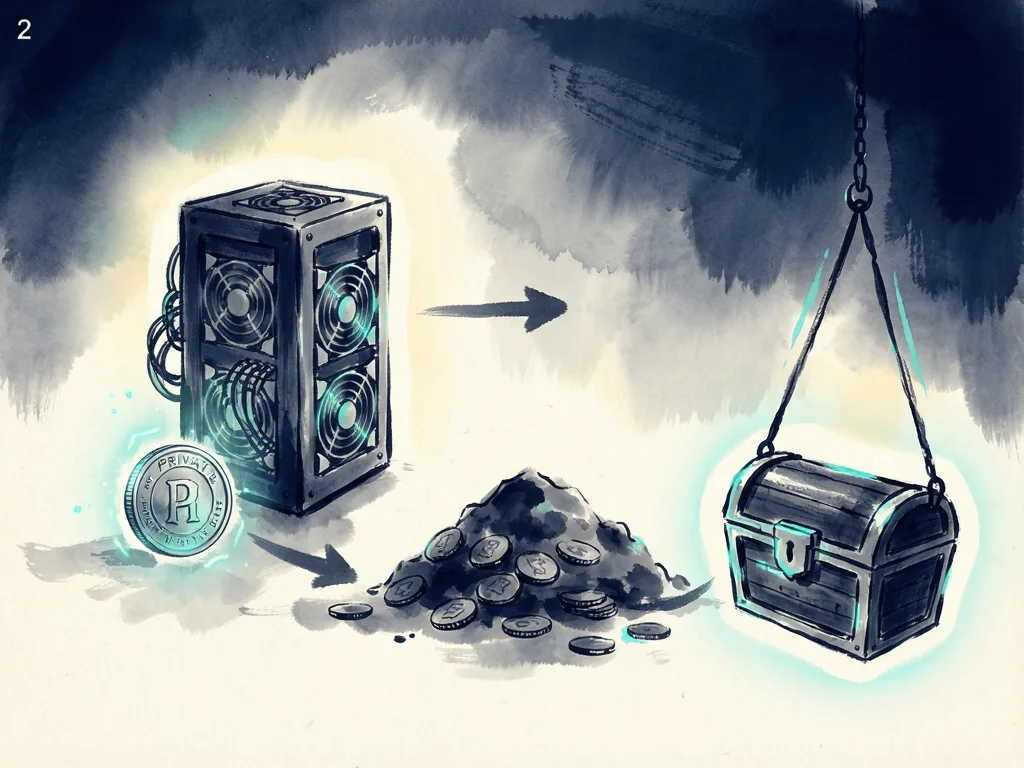
Cypherpunk's November 16 SEC filing shows a 341,858.75 ZEC treasury worth $167.9 million less than at quarter end
What does the November 16 filing show?
Cypherpunk Technologies (Nasdaq: CYPH) reported in a Form 8-K filed with the SEC on November 16, 2026, that its Zcash mining fleet produced 8,967.29 ZEC in 44 days and that the company now holds 341,858.75 ZEC. The attached Exhibit 99.1 release frames that balance as 2.01% of the 17.05 million ZEC in circulation.
The filing frames the quarter around three items, only one of which is directly about mining. The key coin figures are in the exhibit release rather than the cover of the 8-K. That placement can obscure an important distinction: the reported mining revenue of $9.9 million is the fair value of ZEC the company retained, not cash received. The release says all 8,967.29 ZEC earned from August 18 through September 30 went into the treasury.
The company says the August launch of Cypherpunk Mining changed its model because it added mined ZEC to coins purchased separately, while also contributing to the security of the Zcash network. Chief Executive Douglas E. Onsi linked the 8,967.29 ZEC production to an exceptional 95% uptime.
How was the mining fleet assembled?
Cypherpunk did not build the mining operation from scratch. On August 17, it acquired Bitmain Antminer Z15 Pro machines, hosting contracts at three third-party facilities and related deposits from Moria Mining, an affiliate of Winklevoss Treasury Investments, for $33.33 million.
The consideration was a pre-funded warrant for 43,290,042 Cypherpunk shares at $0.001 each, so the purchase used equity rather than cash. The fleet came online on August 18 at roughly 4.2 GSol/s. The company said that represented about 18% of the Zcash network hashrate at closing.
Production began immediately. In October, the fleet added 5,721.35 ZEC at approximately 97% uptime. Between September 30 and the filing date, the company bought another 3,775.72 ZEC on the open market for about $3.475 million, an average of $920.40 per coin.
Because of those later additions, the 341,858.75 ZEC treasury figure is not a September 30 balance. It reflects October mining and November purchases, which is why the release's treasury number is higher than the quarter-end snapshot.
Why does the $167.9 million treasury swing matter?
The third-quarter income statement shows net income of $306.0 million, or $1.44 per basic share, compared with a net loss of $3.3 million in the prior year. The release attributes the gain mainly to a non-cash unrealized gain on an embedded derivative tied to ZEC's move from $400.09 on June 30 to $1,414.56 on September 30.
That mark-to-market history becomes important when the same treasury is revalued at a later price. At $1,414.56, the 341,858.75 ZEC balance would be worth $483.6 million. At the November 17 price of $923.47, the same balance is worth $315.7 million. The difference is $167.9 million, and the coin is 34.7% below the level that produced the third-quarter gain.
The release does not say the fourth quarter will show an exact reverse of that unrealized gain. Still, the same valuation mechanism can move in both directions, and the fourth-quarter filing is where that effect may become visible.
How do the mining economics compare?
The release gives a pre-depreciation mining cost of $104.33 per ZEC, which it describes as 9.44% of the production value of a coin. After depreciation, the stated cost is $237.46, or 21.48% of production value.
Against the November 17 Zcash price of $923.47 reported by CoinGecko, the pre-depreciation cost equals 11.30% of spot. That implies a gross spread of 8.85x on hosting cost alone. Including depreciation, the spread narrows to about 3.9x and the margin is roughly 74%.
Those two figures, more than the revenue headline, determine whether a mining treasury compounds or stalls when the coin falls.
Onsi said the average fair value of mined ZEC was more than $1,100, while hosting cost to mine one ZEC was about $104. The release sets the average fair value at $1,105.46. For readers, the practical point is that revenue based on coin value can look strong while the durability of the margin depends on hosting costs, depreciation, and the market price of ZEC.
What does the 5% supply target require?
Chief Investment Officer Will McEvoy said in the release that the company is continuing to execute on its objective of holding at least 5% of the ZEC supply over time. At the stated 341,858.75 ZEC holding, the company represents 2.01% of total circulating supply.
Using the 17,046,885 coins in circulation cited in the release, 5% equals 852,344 ZEC. The gap is 510,486 ZEC, or about $471.4 million at the November 17 price. If October's 5,721.35 ZEC production were repeated every month and there were no additional purchases, the gap would close in roughly 89 months.
The target also moves because Zcash issuance adds coins with every block. That means the absolute number required for 5% rises over time.
The September agreement with Bitmain therefore matters beyond its headline size. Cypherpunk agreed to buy next-generation Zcash machines for up to $30.0 million, with $6.0 million already paid as a refundable deposit and delivery expected in mid-2027. McEvoy linked that purchase to a target of about 25% of total Zcash network hashrate over time, which would require close to 8 GSol/s against today's network.
The release also shows how network growth can dilute a fixed mining share. Zcash network hashrate rose from about 23 GSol/s on August 18 to about 32 GSol/s on November 13, a 39% increase in under three months. Cypherpunk's deployed 4.2 GSol/s did not change, so its share moved from roughly 18% to 13.1%.
Standing still in a growing network is a losing position even when absolute production holds. A 25% hashrate target on today's network implies a fleet near 8 GSol/s, roughly double the current deployment. With delivery expected in mid-2027, most of 2027 could remain exposed to the same arithmetic if network hashrate keeps climbing.
What does the disclosure leave unresolved?
The release does not name the three hosting counterparties or disclose their power costs. As a result, readers cannot verify from the filing whether the $104.33 cash cost per coin can be sustained after the current contracts end.
The company also does not attach a timetable to the 5% supply objective. It uses the phrase "over time" and describes the goal as one it continues to execute on, not as a commitment with a deadline.
A separate capital-allocation path appears through subsidiary Leap Therapeutics. The release says Leap Therapeutics has opened a strategic process for sirexatamab, which could mean financing the program as an independent entity or transacting with a pharmaceutical company. The company says there is no assurance the process will produce an outcome and that no timetable has been set.
For readers evaluating Cypherpunk as an equity, that means the ZEC treasury strategy is not the only potential use of capital or management attention.
What should readers watch next?
The treasury is marked against a volatile price. ZEC traded at $923.47 on November 17, up 3.4% in 24 hours and down 10.5% over seven days, and about 71% below its all-time high of $3,191.93. CoinGecko also showed Bitcoin down 1.4% and Ether down 1.0% over the same 24 hours. The filing does not explain the move, and the release makes no claim that it does.
The next useful data points are already partly in view: October's production has been counted in the treasury, November's output will appear in the fourth-quarter report, and readers will get the first mark-to-market since the coin fell below $1,000. The 8-K filing index carries the full exhibit set.
Earlier this month, BlockchainReporter covered the Zcash vote on removing 50,000 ZEC from its grants treasury and the NU7 block-rate change that triples Zcash block frequency. Those changes alter the supply and issuance backdrop against which Cypherpunk's treasury is measured.
Cypherpunk TechnologiesZcash miningZEC treasurySEC filingcrypto treasury
Related reading
Comments 0
Never post a seed phrase, private key or screenshot of your wallet in the comments.
- No comments yet.